Door Switch, Timer, BMS, or Continuous Run: Air Curtain Control Options for Commercial Doors
Compare door switches, timers, BMS signals, remote controls, variable speed and continuous operation for commercial entrance air curtains.
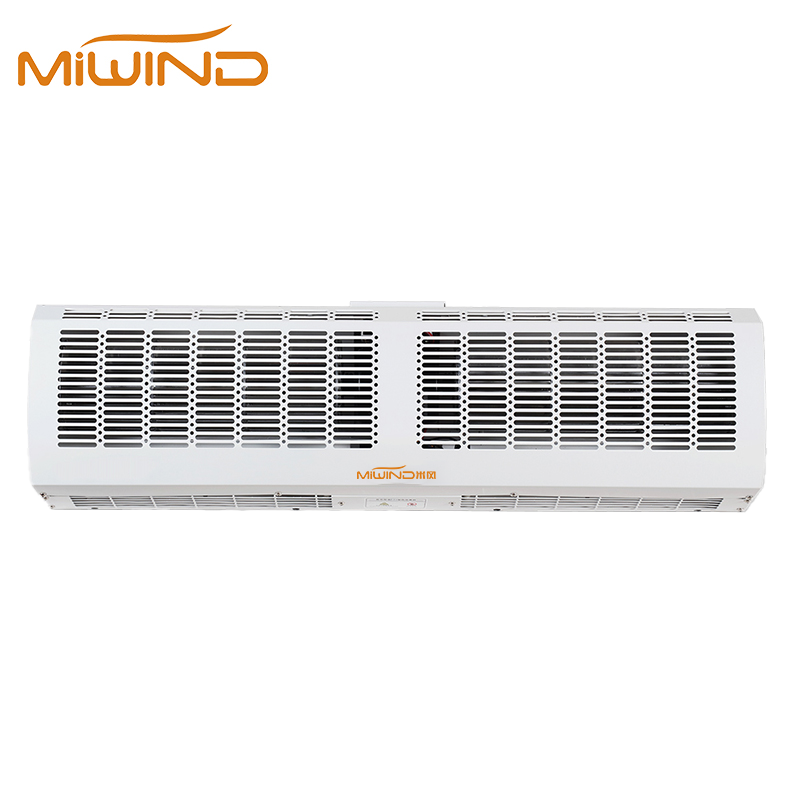
Choose air curtain controls by defining when the fan starts, how it responds to repeated door cycles and who supplies each control component. Identify the available door or building-system signal, any speed or heat sequence, and the responsibility for wiring and commissioning before requesting a quote.
This guide helps facility teams, MEP engineers, electrical contractors, BMS integrators, distributors, and procurement teams compare door switches, delay timers, remote controls, variable speed, BMS coordination, and continuous operation before requesting a MIWIND quote. Final wiring and electrical work must follow the current product documents and qualified installation practice.
Why Control Strategy Changes Performance
An air curtain can be correctly sized and still run at the wrong time. A late start leaves the opening temporarily unprotected. Rapid door cycles can cause repeated starts and stops unless the controller provides an appropriate delay. Continuous operation may create unnecessary noise at a quiet entrance. The control sequence must therefore match the door behavior and the approved product instructions.
Energy-code discussions also make controls important. Some commercial envelope training material and vestibule-exception language discuss air curtain operation with door opening and closing. That does not make every control package code-compliant by itself. It means buyers should ask the project team which adopted code, control behavior, testing reference, and commissioning evidence are required.
Do not stop at the phrase "automatic control." Define what signal is available, what the air curtain should do when the door opens, whether it should continue after closing, who supplies the switch or controller, and which wiring or controls document must be included in the submittal.
Control Options at a Glance
| Door or project condition | Likely control route to review | Quote information needed |
|---|---|---|
| Low-traffic pedestrian door | Door switch or magnetic contact | Door type, switch location, available signal, voltage, and wiring responsibility |
| Frequent retail entrance | Door-linked operation with delay timer or speed control | Door-open duration, traffic bursts, acceptable sound, delay expectation, and staff control needs |
| Automatic sliding door | Door operator signal or separate switch | Whether the door vendor provides an open/close signal, who supplies accessories, and whether the air curtain needs a wiring diagram for the door operator |
| Service or industrial door | Limit switch, door signal, or continuous operation | Door movement, open time, mounting location, traffic, vibration, and switch durability needs |
| Heated air curtain | Fan and heat sequence review | Heat enable logic, thermostat or external signal, safety interlocks, and required electrical documents |
| Multi-door or managed building | BMS, PLC, or scheduled operation | Signal type, status feedback, point list, controller scope, and commissioning responsibility |
| Door held open for long periods | Continuous run or scheduled run | Operating hours, noise exposure, motor-hour expectations, and whether lower speed is acceptable |
The control route should be selected from the real door behavior. A quotation that only says "automatic control" is usually too vague for procurement, installation, and after-sales support.
Once the operating sequence is clear, start with MIWIND air curtain products for the entrance type and use the Air Curtain Series page when the buyer needs to compare product families. For projects with BMS, multiple doors, heated operation, or special control documents, include technical resources and downloads in the document request.
Door-Switch Control for Swinging, Sliding, and Service Doors
Door switches are common because they connect operation to real door movement. A magnetic switch or contact may suit many pedestrian entrances, including some sliding or swinging doors. A mechanical limit switch may suit some service or industrial doors. Automatic doors may provide a control signal through the door operator, but that must be confirmed with the door vendor or controls contractor.
The important buyer question is not "do you have a switch?" It is "what door signal is available, and what control behavior do we want?"
Write the sequence in plain language before asking for a quote:
- Fan starts when the door begins to open.
- Fan continues for a defined delay after the door closes.
- Staff can adjust speed within approved settings.
- Heat mode follows a thermostat, switch, or building command if the unit is heated.
- BMS or PLC points are listed by signal type, not just by the word "BMS."
- The quotation identifies who supplies the switch, relay, controller, cable, and wiring diagram.
For automatic sliding doors, read Air Curtains for Automatic Sliding Doors. That article explains why sensor coordination, traffic cycles, and door signal availability must be reviewed before selecting the control approach.
Typical Operating Sequences
| Sequence | When it fits | What to confirm |
|---|---|---|
| Door opens, fan starts, fan stops when door closes | Lower-traffic doors where simple door-linked operation is enough | Switch type, response time, wiring responsibility, and whether rapid cycling is acceptable |
| Door opens, fan starts, fan runs for a short delay after closing | Retail entrances with traffic bursts or repeated short cycles | Delay duration, staff comfort, sound exposure, and controller availability |
| Fan runs during business hours at a selected speed | Entrances that open very frequently or stay open for long periods | Accepted operating speed, motor hours, sound level, and energy expectations |
| Fan and heat mode follow separate logic | Heated entrance air curtains | Thermostat or heat-enable signal, fan-only mode, safety interlocks, and product documentation |
| BMS sends command or schedule and receives status | Managed buildings, chains, or multi-door projects | Signal type, point list, interface hardware, alarms if required, and commissioning owner |
Use these sequences as RFQ language. Send the closest sequence to MIWIND so the control package can be confirmed before quotation.
Delay Timers vs Continuous Run
A delay timer can keep the air curtain running briefly after the door closes. This can help frequent-cycle entrances where immediate shutdown would create rapid on/off cycling. It can also help stabilize the doorway after a short burst of traffic.
Continuous run can make sense when the door is open often, held open, or used by constant foot traffic. In that scenario, frequent cycling may be less useful than a steady air stream. But continuous operation is not automatically the best answer. It can increase sound exposure, energy use, motor hours, and staff complaints if the entrance is quiet or low traffic.
The right choice depends on real operation:
- Is the door open a few times per hour or every few seconds?
- Does it stay open for carts, luggage, wheelchairs, deliveries, or crowds?
- Is the entrance customer-facing or back-of-house?
- Is the unit heated or ambient?
- Does the owner accept continuous sound at the selected speed?
If sound exposure is a concern, compare the control choice with Quiet Air Curtains for Retail Entrances. A quiet model can still create complaints if the sequence makes it run constantly in a sensitive lobby.
BMS and PLC Coordination Questions
Building management or PLC coordination can be useful for larger facilities, multi-door buildings, heated units, and projects that want centralized scheduling or status monitoring. Common control language may include BACnet, Modbus, 0-10V signals, external on/off, temperature control, speed control, or alarms.
Treat those as questions, not assumptions. Do not assume that every air curtain model includes BMS support. Do not assume that a BMS point list is enough to define the control sequence. Ask:
- What signal does the building system need to send?
- What status does the owner want back?
- Is the air curtain heated, and should heat mode follow temperature?
- Who supplies the controller, sensor, relay, or interface?
- Does the project require a wiring diagram or controls submittal?
- Who commissions the sequence after installation?
For MIWIND projects, write the request as: "Please review BMS or external control feasibility for this model and entrance." Attach the point list, signal type, control sequence, and documentation requirement. This keeps the controls discussion specific enough for procurement and electrical coordination.
For BMS or PLC work, also state whether the project expects dry contact, 0-10V, a named protocol, status feedback, schedule control, alarm feedback, or heat-mode coordination. These details decide whether the quote needs only a standard controller description or a more detailed controls submittal.
Variable Speed and Remote Control
Variable speed helps balance protection and comfort. A high setting may be needed during cold weather, high traffic, or pressure symptoms. A lower setting may reduce noise and draft perception during mild conditions. Staff-facing controls can help, but only if the operating rules are clear.
Remote or wall controls may be useful for shops, restaurants, and public buildings where staff need simple control without accessing the unit. If the project has heated air, controls should also define fan-only mode, heat enable, thermostat behavior, and any safety interlocks.
Ask MIWIND for the product data sheet, control wiring diagram, controller or accessory description, BMS feasibility feedback if required, heat-mode sequence if the unit is heated, and commissioning checklist if the project needs formal submittal records.
What Controls Cannot Fix
Controls cannot fix a blocked discharge path, an undersized unit, a door that is wider than the air stream, a mounting height outside the product's suitable range, or strong negative building pressure. If the doorway is being overpowered by exhaust or wind, a smarter switch may make the timing cleaner but will not solve the airflow physics. For height and coverage questions, review Mounting Height Ratings Explained.
Controls also do not replace local code review. If the project is using an air curtain in a vestibule-exception context, the project team may need performance data, installation instructions, commissioning records, and door-linked operation language. Ask for those requirements before the accessory package is finalized.
RFQ Control Data
Send MIWIND:
- Door type: swinging, sliding, roll-up, service, revolving, or always open.
- Door count and whether multiple units need the same sequence.
- Clear width and height.
- Door operator brand/model if automatic, and any available door-signal document.
- Proposed mounting height and obstruction photos.
- Desired operation: door-linked, delayed off, continuous, scheduled, remote, BMS, or mixed.
- Available door signal or switch preference, including signal type, voltage, dry contact, NO/NC, 0-10V, or protocol if known.
- Desired delay time or sequence after the door closes.
- Traffic intensity and typical door-open duration.
- Whether the unit is heated or ambient.
- Voltage, phase, and control voltage if known.
- Required documents: catalogue, wiring diagram, controller/accessory description, BMS point-list feasibility response, installation guide, code/submittal evidence if applicable, or commissioning checklist.
- Responsibility split: who supplies switch, relay, controller, cable, wiring, BMS integration, and commissioning.
Send this information so MIWIND can confirm the control package before quotation. It also gives the installer and controls contractor a clearer starting point than a quotation that only says "with automatic control."
Related Entrance Guides
For automatic doors, read Air Curtains for Automatic Sliding Doors.
For quote dimensions, read How to Measure a Commercial Entrance Before Requesting an Air Curtain Quote.
For heat-source decisions, read Electric, Hot Water, or Steam Heated Air Curtains.
FAQ
Should an air curtain use a door switch or run continuously?
It depends on traffic. Low-traffic doors often suit door-linked operation, while high-traffic or frequently open doors may need delay timers or continuous operation.
When does a delay timer help?
A delay timer can reduce rapid cycling and keep the air stream active briefly after the door closes. It is useful when traffic arrives in bursts.
Can an air curtain connect to BMS?
Some projects can use external controls or building automation coordination, but support depends on the model, controller, protocol, and project scope. Confirm before ordering.
What signal is needed from an automatic door?
The buyer should confirm whether the automatic door can provide a reliable open/close or control signal, or whether a separate switch is required.
Can controls fix poor mounting or pressure problems?
No. Controls improve timing and operation. They do not fix wrong product coverage, blocked airflow, wind, or negative building pressure.
Request Control Wiring Advice
Use the MIWIND contact page to send your door type, control expectation, traffic pattern, voltage, and required documents. MIWIND can help clarify which control path should be reviewed for your entrance.