Negative Pressure Symptoms: Doors, Drafts and Weak Exhaust
Use door behavior, drafts, odor movement and exhaust timing to prepare a qualified ventilation-balance review.
Negative pressure exhaust fan symptoms are the clues facility teams notice when exhaust removes air faster than the building or room can replace it. A door becomes hard to open, odors move from one zone to another, gaps whistle, smoke spills from a hood, or an exhaust fan seems weak during peak operation. These symptoms do not prove one single cause, but they do justify a supply and exhaust balance review.
This article is for facility managers, restaurant operators, contractors, MEP and HVAC teams, distributors, and retrofit buyers who need to describe what is happening before changing equipment. MIWIND can review ventilation solutions by application, discuss exhaust fan options, coordinate with fresh air system planning, and receive symptoms through Contact Us.
Use this guide to describe symptoms before changing equipment. A final diagnosis may require pressure measurement, airflow checks, balancing calculations, combustion-safety review, code review, or workplace compliance review by qualified professionals.
What Negative Pressure Means In An Exhaust System
Exhaust air, replacement air, and imbalance
When an exhaust fan removes air, replacement air must enter from somewhere. It may come through transfer grilles, door undercuts, supply air systems, windows, wall openings, make-up air systems, or leakage paths. If replacement air is not available, the room can be pulled below adjacent-zone pressure.
Greenheck's make-up air explanation is useful because it frames make-up air as replacement air for exhaust. CCOHS ventilation guidance also explains that ventilation involves supplying and removing air, not only installing a fan.
Why symptoms may appear only when fans run
Pressure symptoms often appear during a specific operating mode. A kitchen hood starts, a restroom exhaust schedule changes, a workshop fan turns on, or multiple fans operate at once. The space may feel normal during low exhaust operation and become difficult only during peak exhaust.
This timing matters. Write down which fans are running, which doors are open or closed, whether HVAC supply and return are active, and whether the symptom changes when one fan is switched off.
Common Symptoms Facility Teams Notice
Hard-to-open doors and inward drafts
Hard doors are one of the easiest symptoms to notice. A door may resist opening, slam inward, or pull air through a gap. Tissue held near a door undercut may move inward. A gap around a closed door may whistle.
These are common negative pressure exhaust fan symptoms, but they are observations rather than a final diagnosis. Door hardware, wind, stack effect, HVAC schedules, or adjacent rooms can also affect door behavior.
Odor migration between rooms or tenants
Odor migration can happen when air moves from a kitchen, restroom, workshop, storage room, waste area, or neighboring tenant into a space that should stay clean. If the pressure path is wrong, odor may move toward the lower-pressure area rather than toward the exhaust capture point.
Strong exhaust may need a planned replacement-air path, especially when occupants notice door pull, odor movement, or hood spillage during fan operation. Treat that as a reason to document the system, not as a reason to choose a larger exhaust fan immediately.
Weak hood capture, smoke spill, or stale air
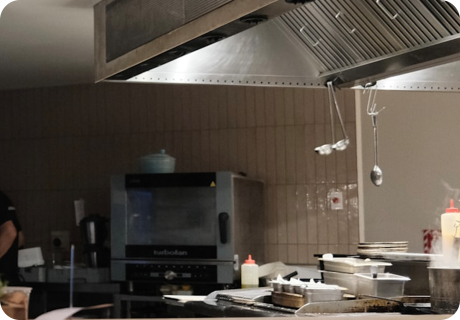
Negative room pressure can also reduce capture performance. A hood may run but still spill smoke or odor if make-up air rushes from the wrong direction, if other fans compete for air, or if the exhaust path is restricted. For kitchen-specific behavior, review kitchen hood capture and containment and where make-up air should enter a restaurant kitchen.
Quick Checks Before Changing Equipment
Door, tissue, smoke, and manometer observations
Simple observations can help describe the issue. A tissue at a gap can show airflow direction. A safe smoke source used by a qualified person can show movement near a hood or doorway. A manometer can record pressure differences between rooms, though interpretation should be handled by a professional.
OSHA's ventilation chapter is a useful safety-oriented reference because it treats ventilation evaluation as a professional practice, not a guess from symptoms alone.
Fan, filter, damper, grille, and duct restrictions
Before adding more exhaust capacity, check whether the existing system is restricted. Dirty filters, blocked grilles, stuck backdraft dampers, crushed duct, undersized duct, clogged terminations, or poor fan inlet conditions can reduce exhaust performance and change pressure behavior.
For the airflow side, read CFM and static pressure basics. For installed low-airflow complaints, use troubleshooting low airflow in an inline fan.
Why More Exhaust May Make The Problem Worse
Make-up air and HVAC supply/return context
Adding a stronger fan can increase the imbalance if replacement air is still missing. A bigger exhaust fan may make doors harder to open, pull odors farther, increase drafts, or weaken capture at another source.
The better question is how exhaust, supply, transfer air, and replacement air operate together. Review make-up air for exhaust fans and balanced ventilation vs. exhaust-only before treating fan size as the only variable.
When To Request A Professional Review
Request a review when symptoms are repeatable, affect safety or operations, involve commercial kitchens or process exhaust, appear around combustion appliances, or cannot be explained by obvious restrictions. Also request review when odor migration affects tenants or adjacent spaces.
MIWIND can help gather product and application information, but the final balance, code, combustion, and safety interpretation belongs to the project engineer, qualified contractor, or local authority.
Symptom Review Checklist For MIWIND
Send the following when asking MIWIND to review negative pressure exhaust fan symptoms:
- Facility type and affected rooms.
- Symptoms, timing, and which fans operate during symptoms.
- Door, draft, odor, smoke, weak capture, or stale-air observations.
- Make-up air source, transfer-air path, and HVAC supply/return status.
- Existing fan model, fan location, photos, duct route, hood or source details.
- Filters, dampers, grilles, louvers, and termination condition.
- Measured pressure if available.
- Engineer-provided airflow if available.
- Combustion appliance presence for professional review.
- Drawings, photos, short videos, market, and timeline.
FAQ
What are common negative pressure exhaust fan symptoms?
Common signs include hard-to-open doors, inward drafts, whistling gaps, odor migration, weak hood capture, smoke spillage, stale air, or symptoms that appear only when exhaust fans run.
Can a stronger exhaust fan fix negative pressure?
Not by itself. If replacement air is missing, a stronger fan can increase the imbalance. The supply air path, exhaust path, restrictions, and controls should be reviewed together.
How can a facility check for possible negative pressure?
Teams can document door behavior, tissue movement, odor paths, smoke movement where appropriate, fan schedules, HVAC status, and measured pressure if a professional uses a manometer.
When should a professional review the system?
Professional review is recommended when symptoms are recurring, affect operations, involve kitchens or process exhaust, involve combustion appliances, or require pressure measurement and balancing decisions.
Next Step: Request A Symptom Review
Use request a symptom review after collecting the checklist details. Clear observations help MIWIND understand the exhaust application before the project team confirms the final pressure diagnosis.