Dehumidifier Capacity Ratings: Pints, Liters and Test Conditions
Compare dehumidifier capacity in US pints/day and liters/day using the same temperature, humidity, test procedure and operating conditions.
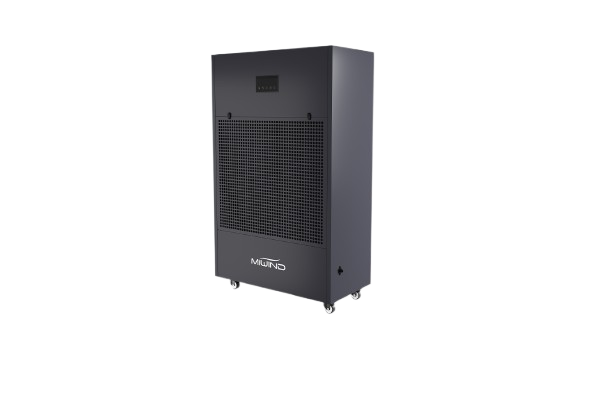
A dehumidifier capacity rating in US pints per day or liters per day states water removal under specified test conditions. Compare the temperature, relative humidity, product category and test procedure with the application before using that rating to size equipment.
This guide explains pints/day, L/day, AHAM-style conditions, real-site derating, airflow, drainage, operating range, and procurement questions. MIWIND can discuss industrial dehumidifier series, the industrial dehumidifier category, technical resources, and capacity questions through Contact Us.
Before comparing final specifications, ask for verified model documents that state the rated condition, capacity, operating range, efficiency basis, and any available performance tables. AHAM-style ratings, Integrated Energy Factor values, low-grain performance, derating curves, certification-program participation, and installed capacity should be confirmed for the exact model under review.
What a Dehumidifier Capacity Rating Actually Means
Capacity is tied to conditions
Capacity is the amount of water removed from air during a defined time period. In many markets it is shown as pints/day or liters/day. The number only makes sense when the rating condition is known: temperature, relative humidity, airflow, test method, and sometimes product category.
ENERGY STAR's dehumidifier testing and capacity page is useful because it explains that capacity ratings changed with newer test conditions and that older and newer ratings should not be compared blindly. The ENERGY STAR efficiency criteria page also shows why capacity and efficiency are connected to defined testing.
Capacity is not a universal installed result
Actual water removal changes with temperature, humidity, airflow and operating time. Check the selected model's performance data at the intended conditions, including the target humidity near the end of a drying cycle.
This is why buyers should compare both the rating number and the condition behind it. A higher number at a favorable condition may not beat a lower number that is documented for the buyer's actual environment.
Pints/Day vs L/Day
US Pints and Liters
One US liquid pint is approximately 0.473 liters. A rating of 40 US pints/day is therefore approximately 18.9 L/day at the same test condition. Specify US liquid pints; an imperial pint is a different unit. Converting units does not adjust performance for a different temperature or humidity.
Pints/day and L/day both express daily moisture removal. Pints/day is common in North America, while liters/day is common in many international quotations. Convert units carefully and keep the same test condition when comparing suppliers.
The unit conversion is not the hard part. The hard part is confirming whether both numbers were measured or stated under comparable conditions. A buyer comparing pints/day at one temperature and L/day at another may be comparing two different promises.
Nameplate, catalogue, and quote language
Ask where the number appears: product label, catalogue table, third-party listing, internal quote, or engineering selection. If the quote uses a capacity different from the catalogue, ask why. It may be a conversion, a different test point, a model variant, or an error.
Use industrial dehumidifier sizing when a capacity figure needs to be connected to room volume, moisture load, door traffic, fresh air, and RH target.
Why Rating Conditions Matter
Temperature and relative humidity
Warm humid air usually gives a dehumidifier more moisture to remove than cool, drier air. A unit may have strong performance at one rating point and lower removal at another. For industrial buyers, site temperature and target RH are not small details; they are central selection inputs.
For US test-procedure requirements, use the DOE dehumidifier test procedure in 10 CFR Part 430, Appendix X1. Record the procedure and represented configuration rather than relying on a copied capacity label.
Airflow and drainage
Air must reach the unit, pass through it properly, and leave without short-circuiting back into the intake. Drainage must also be practical. A blocked drain or poorly routed hose can turn a capacity discussion into a service problem.
Ask for airflow assumptions, installation clearance, whether ducting is involved, condensate pump or gravity drain needs, and maintenance access. Capacity comparison should include the conditions that allow the equipment to operate as intended.
Low-temperature or low-grain operation
Some applications need moisture removal at lower temperatures or lower RH targets. Those conditions can be harder than general comfort dehumidification. Do not assume a capacity number at a standard condition proves performance at a low-temperature storage room or low-grain process.
If low-temperature performance or low-grain performance matters, request model-specific curves or written confirmation. Do not fill the gap with a general catalogue number.
Why Nameplate Capacity Can Mislead Buyers
Nameplate capacity is useful, but it can become misleading when the procurement team treats it as the only decision point. Industrial RFQs need room conditions, drainage, airflow, operating hours, and moisture-source details because the spaces are larger and the loads are less predictable than a simple comfort application.
Common comparison mistakes include:
| Mistake | Better question |
|---|---|
| Comparing capacity without test condition | What temperature and RH produced the rating? |
| Comparing old and new ratings | Are the test methods comparable? |
| Ignoring airflow | What clearance and airflow path are required? |
| Ignoring drainage | How is condensate removed during long operation? |
| Ignoring target RH | What happens near the desired RH range? |
| Ignoring site load | Does the moisture load exceed the catalogue assumption? |
For target setting, see industrial humidity control RH target before final selection.
Spec-Sheet Questions for Procurement Teams
Ask MIWIND:
- What is the stated capacity in L/day or pints/day?
- What temperature and RH condition is tied to that number?
- Is there a model-specific performance table or curve for other conditions?
- What operating temperature and RH range applies?
- What airflow, clearance, filter, and drainage requirements apply?
- What voltage, control, condensate removal, and operating-hour assumptions apply?
- Which documents are available for technical review?
- What site data is needed before recommending a model?
If the buyer already has a required capacity, send the basis for that number. Was it calculated from moisture load, copied from an old installation, estimated from floor area, or specified by a consultant? The answer changes how MIWIND should review the request.
FAQ
What does capacity in pints per day mean?
It means the amount of water a dehumidifier removes in a day under a stated test condition. The condition must be known before comparing products.
Is L/day the same type of rating?
Yes. L/day is another way to express daily moisture removal. Buyers should convert units only after confirming that the test conditions are comparable.
Can nameplate capacity predict field performance?
Not by itself. Field performance depends on temperature, RH, airflow, drainage, operating hours, installation, maintenance, and moisture load.
Where should buyers verify MIWIND capacity ratings?
Use current MIWIND product data for model ratings, test conditions, operating range, and any certified values available for the exact unit.
Next Step: Compare Capacity Options
Send the rated temperature and humidity, site conditions, required moisture removal, drainage, operating hours and application through Contact Us. Include the test basis with every capacity value you want to compare.